Robot Batteries Explained: LiPo vs Li-ion vs NiMH (2026 Buying Guide)

ContentsWhy Battery Choice Matters More Than People Expect
Power supply is the most overlooked part of most beginner robot builds — and the most common reason projects underperform. A robot that "should" run for an hour might die in fifteen minutes, or a motor that should be powerful might stutter, simply because of a mismatched battery. This guide walks through the three battery chemistries you'll actually encounter in hobby robotics, how to size a pack correctly, and how to avoid the mistakes that damage hardware or batteries themselves.
Some articles include recommended robotics gear. We only suggest products we genuinely believe are useful.
Why Battery Choice Matters More Than People Expect
Microcontrollers like the ESP32 and Arduino need very little current and are forgiving about power source. Motors are the opposite: they draw current in bursts, especially at startup, and a battery that can't supply that current will cause voltage to sag, leading to resets, erratic sensor readings, or motors that simply don't move with the torque they're rated for. Picking the right battery chemistry and capacity is as much a part of the build as picking the right motor.
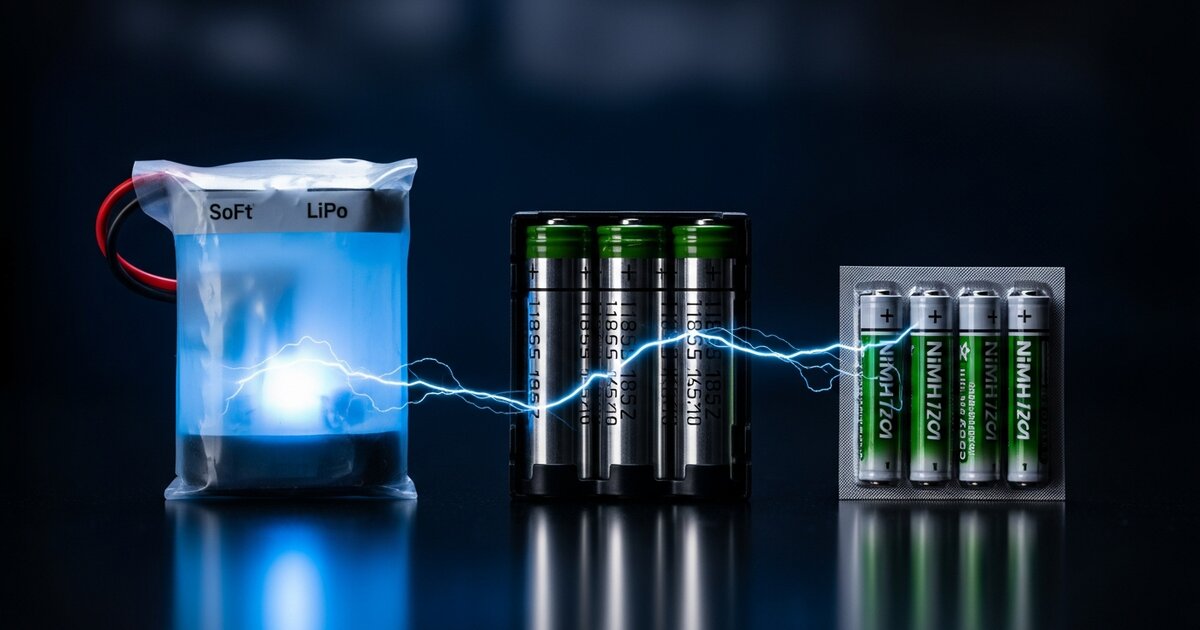
LiPo (Lithium Polymer)
LiPo batteries are the standard choice in performance hobby robotics, RC vehicles, and drones, for good reason.
Pros:
- Very high discharge rates — ideal for motors that draw bursts of current
- Excellent energy density (more capacity per gram than NiMH)
- Available in a huge range of sizes and configurations
Cons:
- Requires a dedicated LiPo-aware charger; cannot be charged like other chemistries
- Sensitive to overdischarge — running below roughly 3.0V per cell can permanently damage the cell
- Physically fragile (puncture or crush damage is a fire risk)
- Needs balance charging on multi-cell packs to keep individual cells at equal voltage
LiPo is the right choice for anything with real torque demands — robot arms lifting load, fast wheeled robots, or anything with multiple motors running simultaneously.
Li-ion (Lithium-Ion, e.g., 18650 cells)
Li-ion cells, most commonly found in the cylindrical 18650 format, offer a different trade-off than LiPo.
Pros:
- Better energy density per dollar than LiPo in many cases
- More physically robust (rigid metal casing vs. LiPo's soft pouch)
- Widely available, reused in many DIY projects (though be cautious with reclaimed cells — see the FAQ below)
Cons:
- Lower maximum discharge rate than LiPo — less suited to high-current bursts
- Still requires careful charging and protection circuitry; same overdischarge sensitivity as LiPo
Li-ion is a strong choice for robots prioritizing runtime over peak power — think a slow-moving rover or a Raspberry Pi-based robot where the compute load matters more than motor torque.
NiMH (Nickel-Metal Hydride)
NiMH is the older, more "forgiving" chemistry, common in standard AA/AAA rechargeable batteries and dedicated RC packs.
Pros:
- Much more tolerant of overdischarge and rough handling — harder to damage through misuse
- Simpler charging requirements, no balance charging needed
- Lower fire risk than lithium chemistries
Cons:
- Lower energy density — more weight and bulk for the same capacity
- Self-discharges faster when sitting unused
- Lower discharge rates than LiPo
NiMH is a sensible choice for beginners' first builds, or for projects where simplicity and safety matter more than squeezing out maximum performance — a basic line-following robot doesn't need LiPo-grade discharge rates.
Sizing Your Battery: Voltage, Capacity, and Discharge Rate
Three numbers matter when choosing a pack:
- Voltage must match (or be regulated down to) what your motors and electronics need. Check your motor driver's rated voltage range.
- Capacity (measured in mAh) determines runtime. Higher capacity means longer runtime but more weight.
- Discharge rate (C rating, for LiPo/Li-ion) determines how much current the battery can safely supply at once. A pack with too low a C rating will sag under load even if its total capacity is sufficient.
A rough rule of thumb: add up the stall current of your motors (check the datasheet), and make sure your battery's maximum discharge current comfortably exceeds that total, with margin for sensors and electronics on top.
Comparison Table
| Chemistry | Discharge Rate | Energy Density | Forgiving of Misuse | Best For |
|---|---|---|---|---|
| LiPo | Excellent | High | Low | High-torque, fast robots |
| Li-ion (18650) | Good | High | Low–moderate | Long-runtime, moderate power |
| NiMH | Moderate | Moderate | High | Beginner builds, simple robots |
FAQ
Can I use a regular USB power bank to power my robot?
For the logic board (Arduino, ESP32, Raspberry Pi) alone, sometimes — but never for motors directly. Power banks typically can't supply the current spikes motors demand, and many shut off automatically when they detect low current draw, which can cause your robot to randomly lose power.
Why did my robot reset itself when the motors started moving?
This is a classic symptom of voltage sag — the motors are drawing more current than the battery (or the wiring) can supply, causing voltage to dip below what the microcontroller needs to stay running. The fix is usually a higher-discharge-rate battery, thicker wiring, or separating motor power from logic power entirely.
Is it safe to use salvaged 18650 cells from old laptop batteries?
This is common in the hobbyist community but carries real risk if you don't know how to test cell health and capacity first. Mismatched or degraded cells can fail unpredictably. If you're new to battery work, buying fresh cells from a reputable supplier is the safer starting point.
Do I need a Battery Management System (BMS)?
For any multi-cell lithium pack (LiPo or Li-ion), yes — a BMS protects against overcharge, overdischarge, and cell imbalance, all of which can otherwise damage the battery or create a safety hazard.
How do I store LiPo batteries safely long-term?
Most LiPo chargers include a "storage charge" mode that brings cells to roughly 50% charge for storage, which significantly extends battery lifespan compared to storing at full charge.
Affiliate disclosure: RoboTechJournal participates in the Amazon Services LLC Associates Program and other affiliate programs. We may earn a small commission when you buy through our links — at no extra cost to you. We only recommend products we have researched or used.