Build a Line-Following Robot from Scratch

ContentsThe Hardware
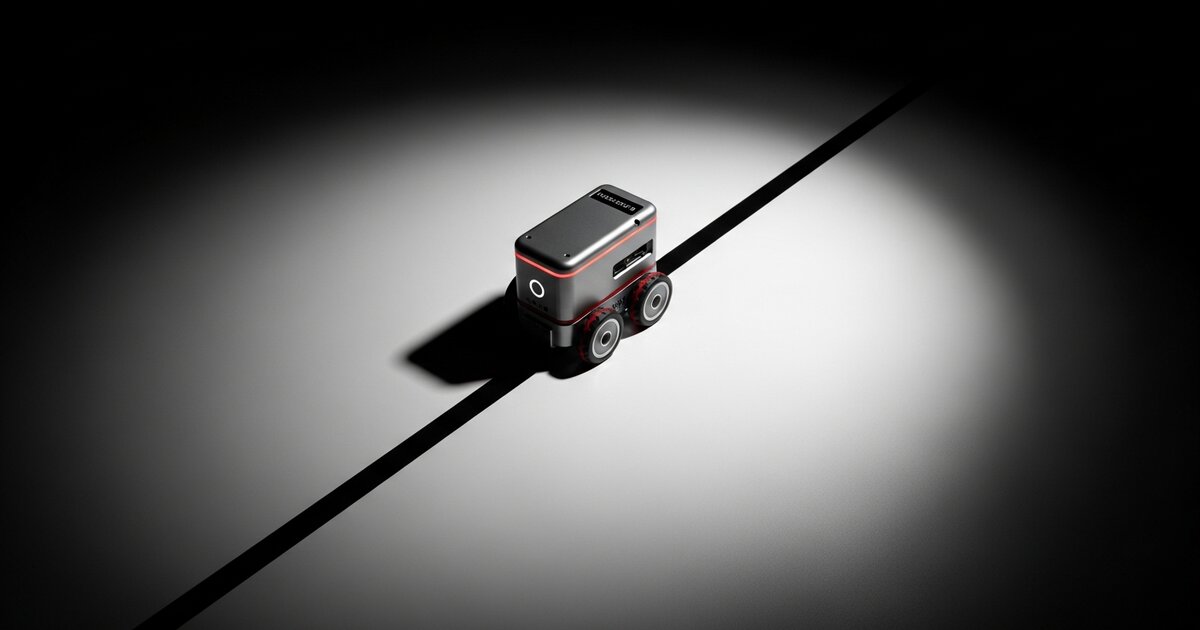
A line-following robot is the classic "Hello World" of autonomous robotics. While simple to build, making one run quickly and smoothly requires understanding control theory.
Some articles include recommended robotics gear. We only suggest products we genuinely believe are useful.
The Hardware
You will need a chassis, two DC gear motors, an L298N or TB6612FNG motor driver, a microcontroller (see our recommendations), and an IR sensor array (e.g., QTR-8RC). The sensor array is critical; using 8 sensors provides much better resolution than a basic 2-sensor setup.
The Problem with Bang-Bang Control
The simplest code logic is: "If the left sensor sees the line, turn left. If the right sensor sees the line, turn right." This is called bang-bang control, and it results in a robot that violently zig-zags down the line.
Implementing PID Control
To achieve smooth, high-speed tracking, we use a Proportional-Integral-Derivative (PID) controller. The PID algorithm calculates an error value (how far off the center of the line we are) and adjusts the motor speeds proportionally.
- Proportional (P): Steers harder the further away from the center you are.
- Derivative (D): Looks at how fast the error is changing, applying a dampening effect to prevent overshoot and oscillation.
- Integral (I): Corrects for small, persistent errors over time (rarely needed for line followers).
Start tuning by setting I and D to zero. Increase P until the robot tracks the line but oscillates. Then, slowly increase D until the oscillation stops.
Recommended Gear
The standard motor driver for beginner robotics. Controls two DC motors independently with PWM speed and direction — works directly with Arduino or ESP32.
8-channel IR reflectance sensor with a dedicated Arduino library. Provides the high resolution needed for smooth PID line tracking.
Acrylic 4-wheel drive chassis with DC gear motors, wheels, and battery holder. A solid, low-cost foundation for a first line-following build.
Affiliate disclosure: RoboTechJournal participates in the Amazon Services LLC Associates Program and other affiliate programs. We may earn a small commission when you buy through our links — at no extra cost to you. We only recommend products we have researched or used.