Servo vs Stepper vs DC Motors: The Complete Guide for Robot Builders

ContentsDC Motors: Simple, Fast, Continuous Rotation
Almost every robotics project eventually runs into the same question: which type of motor actually fits this job? The three most common options — DC motors, servo motors, and stepper motors — aren't interchangeable, and using the wrong one often means more wiring complexity, worse performance, or a part that simply can't do what you need. This guide breaks down how each works and where each one belongs.
Some articles include recommended robotics gear. We only suggest products we genuinely believe are useful.
DC Motors: Simple, Fast, Continuous Rotation
A standard DC motor spins continuously in one direction (or the reverse direction, if you swap polarity) at a speed roughly proportional to the voltage applied. On their own, DC motors have no built-in way to know their exact position or speed — that information has to come from an external sensor, like a wheel encoder, if you need it.
Strengths:
- Cheap and widely available
- Simple to control with a basic motor driver (just voltage and direction)
- High maximum speed relative to cost
Weaknesses:
- No inherent position feedback — you don't know exactly how far the shaft has turned unless you add an encoder
- Speed varies with load and battery voltage unless you add closed-loop control
Best for: wheels on a mobile robot, fans, anything where continuous rotation at variable speed is the goal rather than a precise stopping position.
Geared DC Motors
Worth calling out separately: most "DC motors" used in robotics are actually geared DC motors, where an internal gearbox trades speed for torque. A raw DC motor often spins far too fast and with too little torque to be useful directly — gearing it down (say, 1:48) makes it practical for driving wheels. When shopping, the gear ratio listed matters as much as the voltage rating.
Servo Motors: Precise Position Control, Limited Range
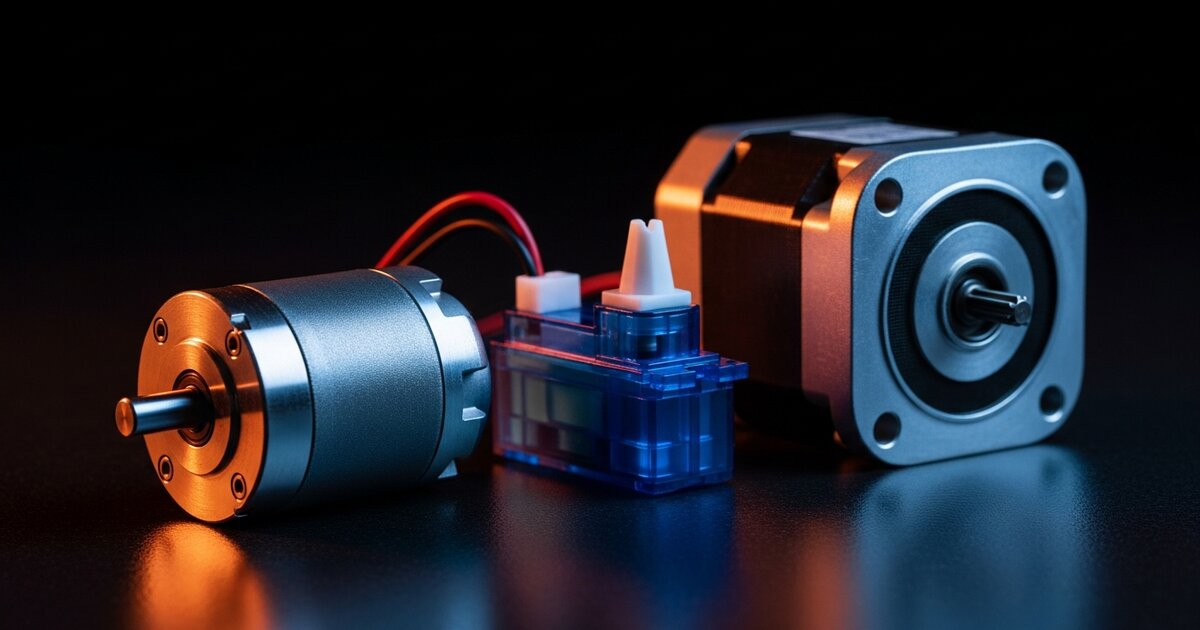
A servo motor combines a small DC motor, a gearbox, and a built-in feedback system (typically a potentiometer) that lets it move to and hold a specific angular position — typically within a roughly 180-degree range for standard hobby servos, though some "continuous rotation" servos exist as a special case.
Strengths:
- Precise, repeatable positioning without needing your own feedback loop
- Simple control interface (a single PWM signal sets the target angle)
- Reasonably high torque-to-size ratio, especially with digital/metal-gear servos
Weaknesses:
- Limited rotation range on standard servos (continuous-rotation servos exist but sacrifice positional control)
- Lower top speed than a comparable DC motor
- Cheaper analog servos can be imprecise and prone to "jitter"
Best for: robot arm joints, steering mechanisms, camera pan/tilt mounts, gripper actuation — anywhere you need the motor to reliably reach and hold a specific position.
Stepper Motors: Precise, Repeatable, No Feedback Needed
Stepper motors move in small, fixed increments ("steps") rather than spinning freely. A controller sends a sequence of pulses, and the motor advances one step per pulse — meaning you can track exact position just by counting steps, without needing a separate position sensor.
Strengths:
- Excellent positional accuracy and repeatability without feedback hardware
- Strong holding torque — stays in position even without active control
- Open-loop control is straightforward (count steps, you know position)
Weaknesses:
- Can "lose steps" if overloaded — and in basic open-loop setups, you won't know it happened
- More complex driver electronics than a basic DC motor
- Generally lower top speed and less efficient than DC motors for continuous rotation tasks
Best for: 3D printer-style linear motion, camera sliders, robot arms requiring very precise joint control, any application demanding repeatable positioning without the cost of closed-loop feedback systems.
Side-by-Side Comparison
| Factor | DC Motor | Servo Motor | Stepper Motor |
|---|---|---|---|
| Continuous rotation | Yes | Limited (standard) | Yes (in steps) |
| Built-in position feedback | No | Yes | No (open-loop) |
| Positional accuracy | Low (needs encoder) | Good | Excellent |
| Holding torque at rest | None (free-spins) | Moderate | High |
| Control complexity | Simple | Simple | Moderate–high |
| Typical use | Wheels, fans | Arm joints, steering | Precise linear/rotary motion |
Choosing for Your Project
- Wheeled mobile robot: geared DC motors, almost always.
- Robot arm with multiple joints: servo motors for hobbyist builds; steppers for precision-focused or industrial-style builds.
- Camera gimbal or pan/tilt mount: servo motors, for their simple positional control.
- 3D printer-style gantry or precise linear actuator: stepper motors, paired with belts or screws.
- Mixed builds: many robots use all three — DC motors for wheels, servos for a camera mount, and possibly a stepper for a precision tool head or scanning mechanism.
FAQ
Can I get precise positioning from a DC motor?
Yes, by adding a rotary encoder and implementing closed-loop control (often PID) in your code — this is essentially what a servo motor does internally, just exposed for you to build yourself. It's more work but offers more flexibility than a standard hobby servo.
Why did my stepper motor skip or lose position?
This usually means the motor was asked to move faster or with more torque than it could deliver, causing it to miss steps. Reducing speed, increasing current (within the motor's rated limits), or using a higher-torque motor typically resolves it.
Are brushless DC motors (BLDC) different from regular DC motors?
Yes — BLDC motors replace the mechanical brushes of a standard DC motor with electronic commutation, offering longer lifespan and better efficiency, but requiring a more complex (and more expensive) motor controller (an ESC, as used in drones).
Do servos need a separate power supply?
For small servos doing light work, power from the same source as your logic board may be fine. For larger or multiple servos moving simultaneously, a separate, adequately rated power supply (see our battery guide) avoids voltage sag that can cause erratic behavior or resets.
What's the easiest motor type for an absolute beginner?
Geared DC motors with a simple motor driver (like the L298N) are the easiest entry point — minimal wiring, simple code, and forgiving of basic mistakes. Servos are a close second, since a single PWM signal handles positioning directly.
Affiliate disclosure: RoboTechJournal participates in the Amazon Services LLC Associates Program and other affiliate programs. We may earn a small commission when you buy through our links — at no extra cost to you. We only recommend products we have researched or used.