Robot Vacuum Teardowns: Salvaging Parts for DIY Robotics Projects

ContentsWhy Robot Vacuums Are a Great Salvage Source
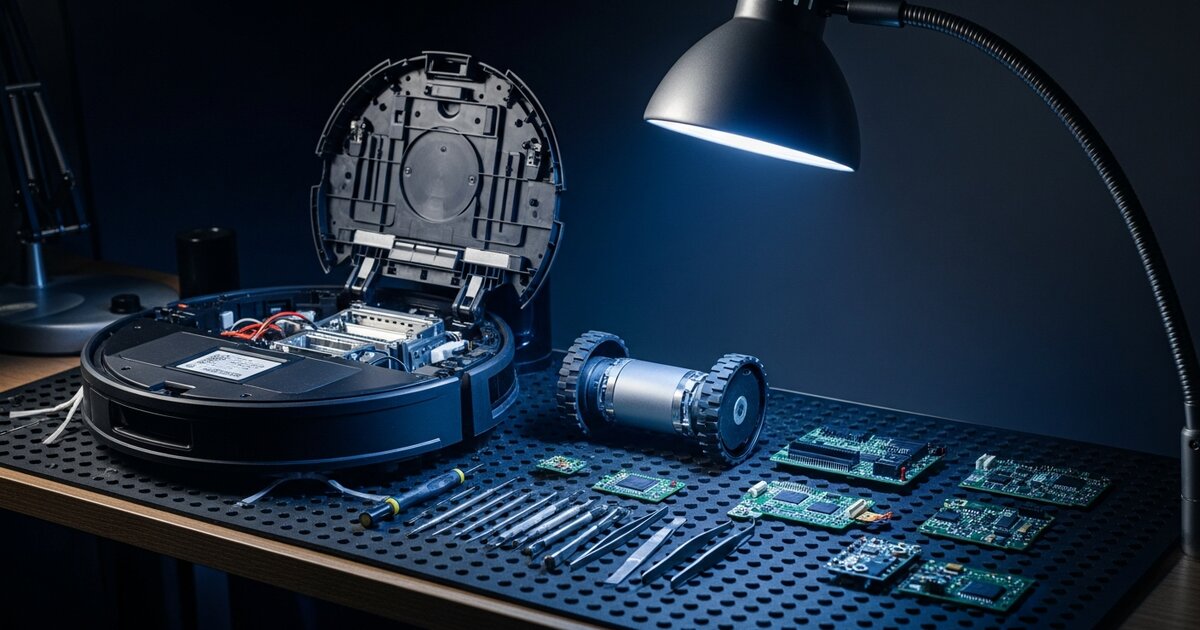
A broken or outdated robot vacuum heading for the bin is, to a robotics hobbyist, a box of genuinely useful components — motors, wheel assemblies, sensors, and batteries that would otherwise cost real money to buy individually. This guide covers what's actually worth salvaging from a robot vacuum teardown, what to test before reusing, and what to skip.
Why Robot Vacuums Are a Great Salvage Source
Robot vacuums are mass-produced at a scale that makes their individual components cheap relative to buying equivalent parts new — and because they're designed to navigate autonomously, they're packed with exactly the kind of sensors and motors hobbyists want: wheel motors with encoders, cliff sensors, bump sensors, and sometimes even basic LiDAR or camera modules in higher-end models.
Sourcing options include broken units from secondhand marketplaces, units headed for e-waste recycling, or older models replaced by an upgrade — often available very cheaply since most buyers don't realize the parts inside have value.
What's Worth Salvaging
Wheel Motors with Encoders
This is the single most valuable component for most builders. Robot vacuum drive wheels typically use geared DC motors with built-in quadrature encoders — exactly the setup needed for closed-loop speed and position control in a DIY mobile robot, and these often cost considerably more to buy new individually than an entire used vacuum costs secondhand.
Cliff and Bump Sensors
Robot vacuums use infrared cliff sensors (to avoid driving off stairs) and mechanical or capacitive bump sensors (to detect collisions). Both are straightforward to reuse: cliff sensors are simple IR emitter/detector pairs, and bump sensors are often just microswitches — both well within reach of a basic Arduino project.
Batteries (With Caution)
Robot vacuums typically use Li-ion packs. These can be salvaged, but only with proper testing — a pack pulled from a vacuum that died because of a battery fault may have a degraded or damaged cell. Test individual cell voltages and capacity before reusing, and never assume a pulled battery pack is safe by default. If you're not comfortable testing lithium cells, it's safer to recycle the battery and buy fresh ones (see our battery guide).
Wheels and Mechanical Assemblies
Drive wheels, caster/omni wheels, and the brush motor assembly are often directly reusable or easy to adapt, saving you from designing and printing your own wheel mounts from scratch.
Main Control Boards (Limited Value)
The main PCB is usually the least useful salvage target — it typically runs proprietary firmware with no public documentation, making it very difficult to repurpose directly. Most hobbyists discard the main board and replace it entirely with their own microcontroller (see our ESP32 vs Arduino vs Raspberry Pi guide), wiring the salvaged motors and sensors to that instead.
What to Test Before Reusing Anything
- Motors: connect briefly to a bench power supply at the motor's rated voltage and confirm smooth rotation in both directions, listening for grinding or excessive noise that suggests gearbox wear.
- Encoders: verify pulse output using an oscilloscope or simple test sketch while manually rotating the shaft.
- Batteries: measure individual cell voltages; a healthy Li-ion cell should sit within its normal voltage range (consult the cell's datasheet), and any cell reading drastically lower than its neighbors should be treated as suspect.
- Sensors: test IR sensors and switches with simple multimeter continuity checks or a basic test sketch before integrating them into a larger build.
A Simple First Project: Vacuum-Motor Line Follower
A practical first project for salvaged parts: take a pair of geared motors with encoders from a robot vacuum, mount them in a simple printed or laser-cut chassis, and build a closed-loop line-following robot (extending the concepts in our line-following build guide) using the encoders for accurate speed matching between the two wheels — something a basic open-loop line follower can't do as precisely.
FAQ
Is it safe to reuse a battery from a broken robot vacuum?
Only after testing. If the vacuum died due to a battery issue specifically, treat the pack with extra caution. Test individual cell voltages, and if anything looks abnormal (physical swelling, very low voltage, large voltage differences between cells), recycle the pack rather than reusing it.
Can I reuse the robot vacuum's onboard SLAM/mapping sensors?
Sometimes, for higher-end models with discrete LiDAR or camera modules — but these often communicate with the main board using proprietary protocols that aren't documented, making them difficult to repurpose. Basic IR cliff sensors and bump switches are far easier wins.
Where can I find robot vacuums to salvage cheaply?
Secondhand marketplaces, local electronics recycling events, and "broken/for parts" listings are common sources. Vacuums with motor or battery faults (rather than fire/water damage) tend to have the most usable internals.
Do salvaged motors work with standard motor drivers?
Generally yes — most robot vacuum drive motors are standard brushed DC motors that work fine with common drivers like the L298N, as long as the driver is rated for the motor's voltage and current draw.
Is salvaging parts actually cheaper than buying new components?
Often yes, especially for motors with built-in encoders, which can be one of the pricier individual components to buy new. The trade-off is unpredictability — you don't know a part's condition until you test it, so factor in some failure rate when deciding whether salvaging makes sense for your budget and timeline.