Best Robotics Programming Languages: Python vs C++ vs MicroPython

ContentsC++: The Language of Real-Time Control
One of the most common questions from people starting in robotics isn't about hardware at all — it's which programming language to actually learn first. The honest answer is that serious robotics work usually involves more than one language, each suited to a different layer of the system. This guide breaks down where Python, C++, and MicroPython each fit, so you can choose based on what you're actually building rather than guessing.
C++: The Language of Real-Time Control
C++ is the dominant language for code that needs to run fast and predictably — which describes a lot of low-level robotics work. Arduino sketches are technically written in a simplified C++ dialect, and most of ROS 2's performance-critical packages (motor control, sensor drivers, navigation algorithms) are written in C++ as well.
Strengths:
- Predictable, fast execution with minimal overhead — important for real-time control loops
- Direct hardware access and memory control, useful for embedded systems with limited resources
- The standard language for performance-critical ROS 2 nodes
Weaknesses:
- More verbose and harder to learn than Python, with manual memory management as a common source of bugs for beginners
- Slower to prototype and iterate compared to a scripting language
Best for: Arduino/microcontroller firmware, real-time motor control loops, performance-critical ROS 2 nodes.
Python: The Language of Prototyping and AI
Python has become the default language for the "thinking" layer of robotics — computer vision, machine learning, high-level decision logic, and rapid prototyping — largely because of its massive ecosystem of libraries (OpenCV, PyTorch, TensorFlow, NumPy) and how quickly you can go from idea to working code.
Strengths:
- Extremely fast to write and iterate, ideal for testing ideas before committing to a more rigid implementation
- The dominant language for machine learning and computer vision libraries used in robotics (covered in our custom object detection guide)
- Fully supported in ROS 2 for writing nodes, with a much gentler learning curve than C++
Weaknesses:
- Slower execution than C++, which matters for genuinely real-time, low-latency control tasks
- Less suited to resource-constrained microcontrollers (though MicroPython, below, addresses this in a limited way)
Best for: computer vision, AI/ML pipelines, high-level robot logic and decision-making, rapid prototyping, most non-time-critical ROS 2 nodes.
MicroPython: Python's Reach into Microcontrollers
MicroPython is a lean implementation of Python designed to run directly on microcontrollers like the ESP32, bringing Python's easier syntax to hardware that would otherwise require C++.
Strengths:
- Much faster to write and debug than C++ for simple microcontroller tasks
- Familiar Python syntax, useful if you're already comfortable with Python from other parts of a project
- Good support on popular boards including the ESP32 (see our ESP32 vs Arduino vs Raspberry Pi guide)
Weaknesses:
- Slower execution than C++ on the same hardware, which can matter for tight real-time timing requirements
- Smaller ecosystem and community compared to standard Arduino C++ resources
- Higher memory overhead than C++, a real constraint on memory-limited boards
Best for: ESP32/microcontroller projects where development speed matters more than maximum performance, beginners who already know Python and want to avoid learning C++ immediately.
Comparison Table
| Factor | C++ | Python | MicroPython |
|---|---|---|---|
| Execution speed | Fastest | Slower | Slower than C++, runs on MCU |
| Learning curve | Steep | Gentle | Gentle |
| Runs on microcontrollers | Yes (native) | No | Yes |
| AI/ML library support | Limited | Excellent | Very limited |
| Best layer | Low-level/real-time | High-level/AI | Low-level, easier syntax |
How They Work Together in a Real Project
Many serious robots — including most ROS 2-based builds — use multiple languages simultaneously, with the language matched to the job:
- Microcontroller firmware (motor control, low-level sensor reading): C++ (Arduino) or MicroPython, depending on whether raw performance or development speed matters more
- Mid-level robot logic and ROS 2 nodes: Python, for most nodes where execution speed isn't the bottleneck
- Performance-critical ROS 2 nodes (e.g., point cloud processing, certain navigation components): C++
- AI/vision models: Python, almost universally, given the ecosystem of available libraries
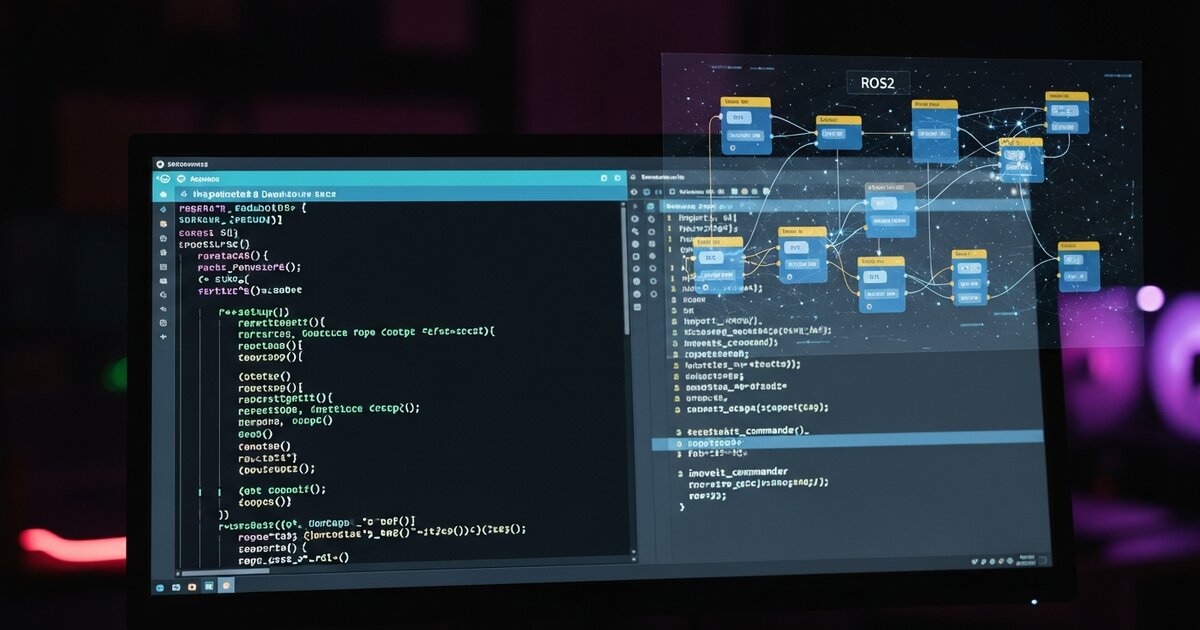
This is why our ROS 2 for Beginners guide doesn't commit to a single language — ROS 2 itself is designed to let you mix C++ and Python nodes freely within the same robot.
Which Should You Learn First?
- Coming from no programming background, want to start with hardware: start with Arduino's C++ dialect — it's simplified compared to "real" C++ and pairs naturally with your first hardware projects.
- Coming from no programming background, interested in AI/vision more than hardware: start with Python — the ecosystem and learning resources for beginners are enormous.
- Already know Python, want to move into microcontrollers without learning C++ immediately: MicroPython is a reasonable bridge, with the option to move to C++ later for performance-critical work.
FAQ
Do I need to learn C++ to do robotics with Python?
Not necessarily for hobby projects — many beginner and intermediate builds can be done entirely in Python (especially with MicroPython on the microcontroller side), with C++ becoming more relevant as you move into performance-sensitive ROS 2 work or want to push hardware limits.
Is MicroPython too slow for real robotics projects?
For many hobby projects, no — simple sensor reading and motor control loops run perfectly well in MicroPython. It becomes a real limitation for very tight timing requirements (high-frequency PID loops, precise multi-motor synchronization), where C++ has a clear advantage.
Can I mix C++ and Python in the same robot project?
Yes, and it's extremely common — particularly in ROS 2 projects, where C++ and Python nodes communicate over the same topic/message system regardless of which language each node is written in.
Is Python fast enough for real-time computer vision on a robot?
With the right libraries (OpenCV, and hardware acceleration via something like a Jetson board's TensorRT — see our Jetson buying guide), Python-based vision pipelines can run in real time. The heavy computation happens in optimized C/C++ libraries under the hood, with Python serving as the orchestration layer.
What language does ROS 2 itself use?
ROS 2's core is written in C++, but it officially supports writing your own nodes in either C++ or Python, with both treated as first-class options in the framework.